Local Tips
Plumbing Problems in Older Union County Homes: The Big Three
9 min read · Published October 6, 2025
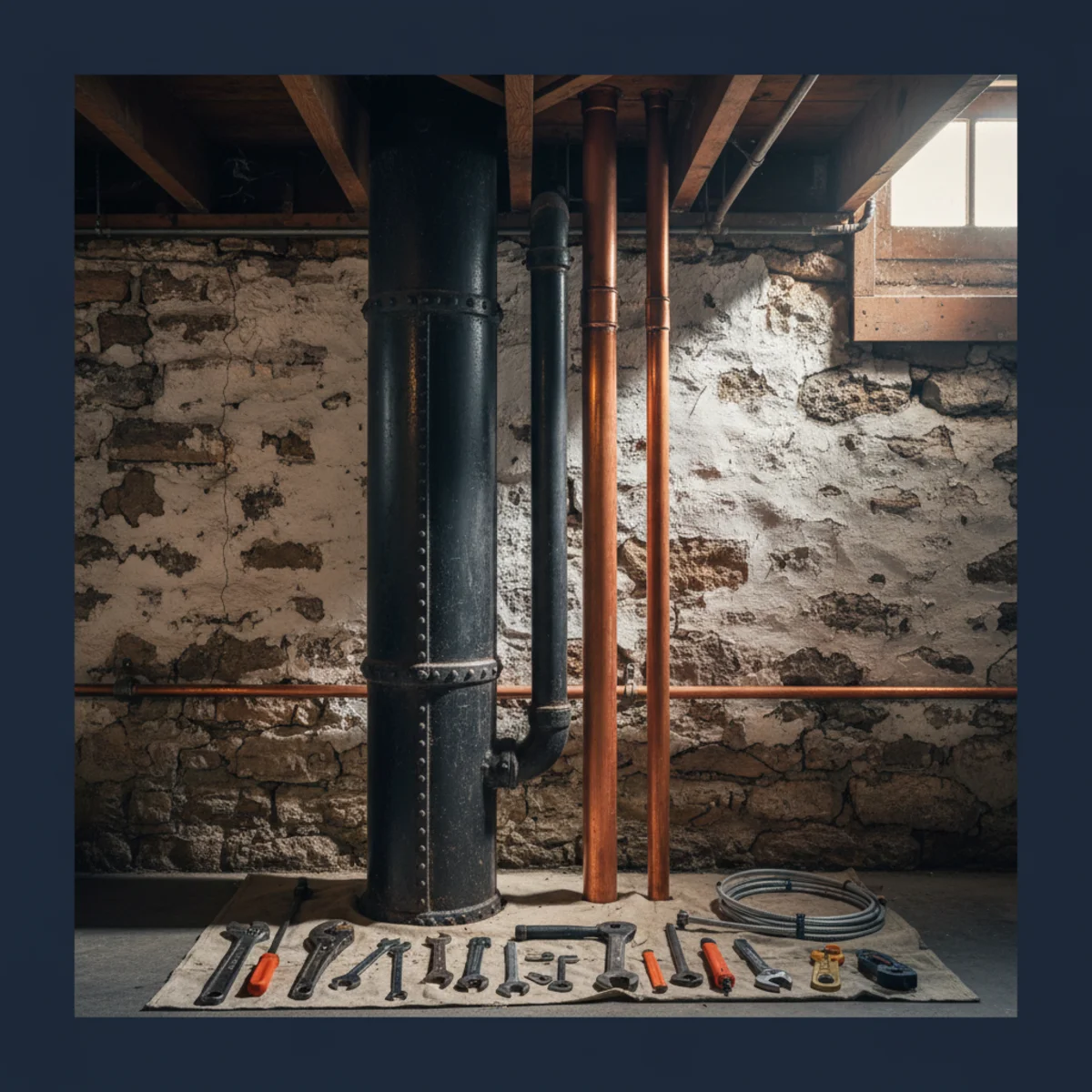
If your Union County home was built before 1970, three aging materials cause most of its plumbing headaches. Here is how to recognize cast iron, galvanized pipe, and clay lateral failure before it floods you.
Key Takeaways
- Three materials cause most trouble in pre-1970 homes: cast iron, galvanized, and clay laterals.
- Cast-iron drains rust from inside; whole-house slow drains and a flaking stack are the tells.
- Galvanized supply pipe strangles itself shut — gradual whole-house pressure loss is the classic sign.
- Clay sewer laterals let roots in at the joints, causing repeat main-line backups in the basement.
- A camera inspection shows the real condition inside before you decide to repair or replace.
Old Houses, Old Pipes, Predictable Failures
Union County is full of beautiful older housing. Roselle Park's early-1900s frames, Roselle's porch-front colonials, Kenilworth's post-war capes, the brick rows in Elizabeth — they have character that newer construction cannot fake. They also share a plumbing reality: the materials inside the walls and under the floor have a service life, and a lot of them are at or past it.
The good news is that old-home plumbing fails in patterns. After enough basements, you stop being surprised. Three materials cause the overwhelming majority of the trouble: cast-iron drain lines, galvanized steel supply pipe, and clay sewer laterals out to the street. Each ages differently, shows different warning signs, and forces a different repair-versus-replace decision.
This guide walks through all three so you can recognize what you are dealing with. None of this means your house is a money pit. It means you should know what you have, watch for the early signs, and make replacement decisions on your schedule instead of at 2 a.m. with water on the floor. When you want a straight read on your own pipes, call (207) 419-2600 — but first, here is what to look for.
Cast Iron: The Drain Lines That Rust From Inside
Cast iron was the standard drain and vent material for decades, and it is genuinely durable — until it is not. The failure happens from the inside. Decades of waste flow scour the bottom of horizontal runs while the top corrodes, and the pipe gradually loses its walls. Vertical stacks rust at the joints and the base.
The telltale signs are subtle at first. Recurring slow drains across the whole house, not just one fixture, often mean the cast-iron line is scaling shut internally. Brown staining or flaking rust on the outside of a basement stack is a red flag. So is a sewer-gas smell that you cannot trace to a dry trap, because a corroded pipe can crack and leak gas before it leaks water.
The honest part: you cannot patch your way out of late-stage cast iron. A single bad section can be cut out and replaced, but when the pipe is flaking and weeping in several spots, you are spending good money on a line that will fail again a foot away. A camera sewer inspection is the cheapest way to see the actual condition inside before you decide. It shows you whether you have years left or whether the run needs pipe replacement.
Galvanized Steel: The Supply Pipe That Strangles Itself
If your home still has its original supply lines from before the 1960s, there is a good chance they are galvanized steel — and galvanized has one inevitable failure mode. The zinc coating wears off, the steel underneath rusts, and that rust builds up on the inside of the pipe. Over decades the pipe literally closes itself off, narrowing from a half-inch opening down to a pencil's width.
The classic sign is weak water pressure that has gotten worse over the years, especially upstairs and especially when more than one fixture runs at once. Rusty or brownish water on the first draw, particularly from the hot side, is another. Sometimes you will see the threaded joints weeping or crusted with corrosion in the basement.
This is one where patching is usually false economy. Replace a corroded galvanized section and you have a shiny new fitting bolted to a pipe that is still closing up on both sides of it — pressure barely improves. When galvanized pipe is the problem, the real answer is usually repiping the affected runs in copper or PEX. It is a bigger project, but it solves the pressure problem for good instead of chasing it fitting by fitting.
Clay Sewer Laterals: Where the Roots Get In
Out beyond your foundation, the pipe carrying waste to the street main is your sewer lateral — and in older Union County neighborhoods, a lot of those laterals are vitrified clay. Clay is tough against corrosion but it has a fatal flaw: it is laid in short sections with joints, and over a century those joints loosen, shift in the soil, and let in two things you do not want — groundwater and tree roots.
Across Roselle Park and its neighbors, the streets are lined with mature trees, and those roots are relentless about finding the trickle of moisture and nutrients at a leaking clay joint. Once a root hair gets in, it grows into a mass that snags everything flushing past it. The signs are recurring main-line backups, gurgling toilets, multiple fixtures backing up at once, and that backup tending to surface at the lowest drain in the basement first.
Roots can be cut back with a rooter machine, which buys time, but they grow back because the cracked joint is still there. A camera inspection tells you whether you are managing a recurring root problem or looking at a collapsed section that needs a full sewer line repair. Call (207) 419-2600 if your main backs up more than once — that is the lateral asking for attention.
How to Tell Which Problem You Have
The three failures show up in different places, which makes them easier to sort out than you would think.
If the issue is weak water pressure or discolored water coming out of your faucets, you are looking at the supply side — most likely galvanized pipe. Pressure problems live on the clean-water lines that feed your fixtures.
If the issue is slow or backing-up drains inside the house, isolated to upper floors or specific branches, suspect the cast-iron drain lines scaling shut. If it is the whole house backing up at once, or a backup that surfaces in the basement, the problem has moved out to the main line or the clay lateral.
Age is your best clue. A pre-1960 home that has never been updated likely has all three materials in play. A home that was partially renovated may have new copper at the fixtures but original galvanized in the walls, or new interior drains but the same century-old clay lateral underground. The only way to know for certain is to look — at the visible pipe in the basement and, for the buried lines, with a camera.
Repair or Replace: An Honest Framework
Homeowners always want the same answer: do I have to replace it, or can I keep patching? Here is the framework we actually use.
Replace when the material is failing systemically, not in one spot. One cracked cast-iron section in an otherwise sound line is a repair. A line that is flaking and weeping in several places is a replacement, because patching it just moves the next failure a few feet down. Same logic on galvanized: one bad fitting is a repair, but whole-house pressure loss from corrosion is a repiping conversation.
Weigh the cost of repeat repairs against one larger fix. If you are snaking the same clay lateral twice a year, you are renting a solution that a proper sewer repair would own outright. At some point the repeat bills exceed the permanent fix.
Factor in what is above the pipe. A failing line under a finished basement or a paved driveway raises the stakes — and sometimes makes a trenchless repair worth considering, though trenchless is not always cheaper or even possible, depending on the line's condition. We will tell you that straight rather than sell you the fancier option by default.
Buying or Selling an Older Union County Home
If you are about to buy a pre-1970 home in Roselle Park, Roselle, or anywhere across the county's older neighborhoods, the plumbing is worth real attention before you sign. A standard home inspection looks at what is visible; it does not put a camera down the sewer lateral, and the lateral is exactly where the most expensive surprises hide.
A pre-purchase plumbing inspection with a sewer camera tells you what you are actually buying — whether the clay lateral is intact or full of roots, whether the supply lines are original galvanized, and what condition the cast-iron stack is in. That knowledge changes negotiations. It is far better to know about a failing lateral before closing than to discover it the first time the basement floods.
Selling works the same way in reverse. Knowing the condition of your three big systems lets you fix or disclose on your terms. Either side of a deal, getting an honest assessment of an older home's plumbing is one of the higher-value calls you can make. Reach us at (207) 419-2600 and we will tell you what we find, not what is convenient to sell.
Frequently Asked Questions
Keep Reading
Local Tips
When to Call a Local Plumber vs. Do It Yourself
Some plumbing jobs are perfectly safe for a confident homeowner. Others quietly turn a small problem into an expensive one. Here is an honest decision tree for knowing which is which.
8 min read · May 4, 2026

Local Tips
How to Choose a Plumber in Roselle Park, NJ
Hiring a plumber in Roselle Park should not be a gamble. This guide shows you how to verify a New Jersey license, confirm insurance, understand permits, and read an estimate before you sign.
9 min read · February 12, 2026
Local Tips
Winter Plumbing Tips for New Jersey Homeowners
A New Jersey winter finds every weak spot in your plumbing. This guide walks through the freeze prep that actually prevents burst pipes, plus what to do the morning a line freezes anyway.
9 min read · November 30, 2025