Drain & Sewer
How Tree Roots Get Into Your Sewer Line (And What It Costs You)
8 min read · Published August 25, 2025
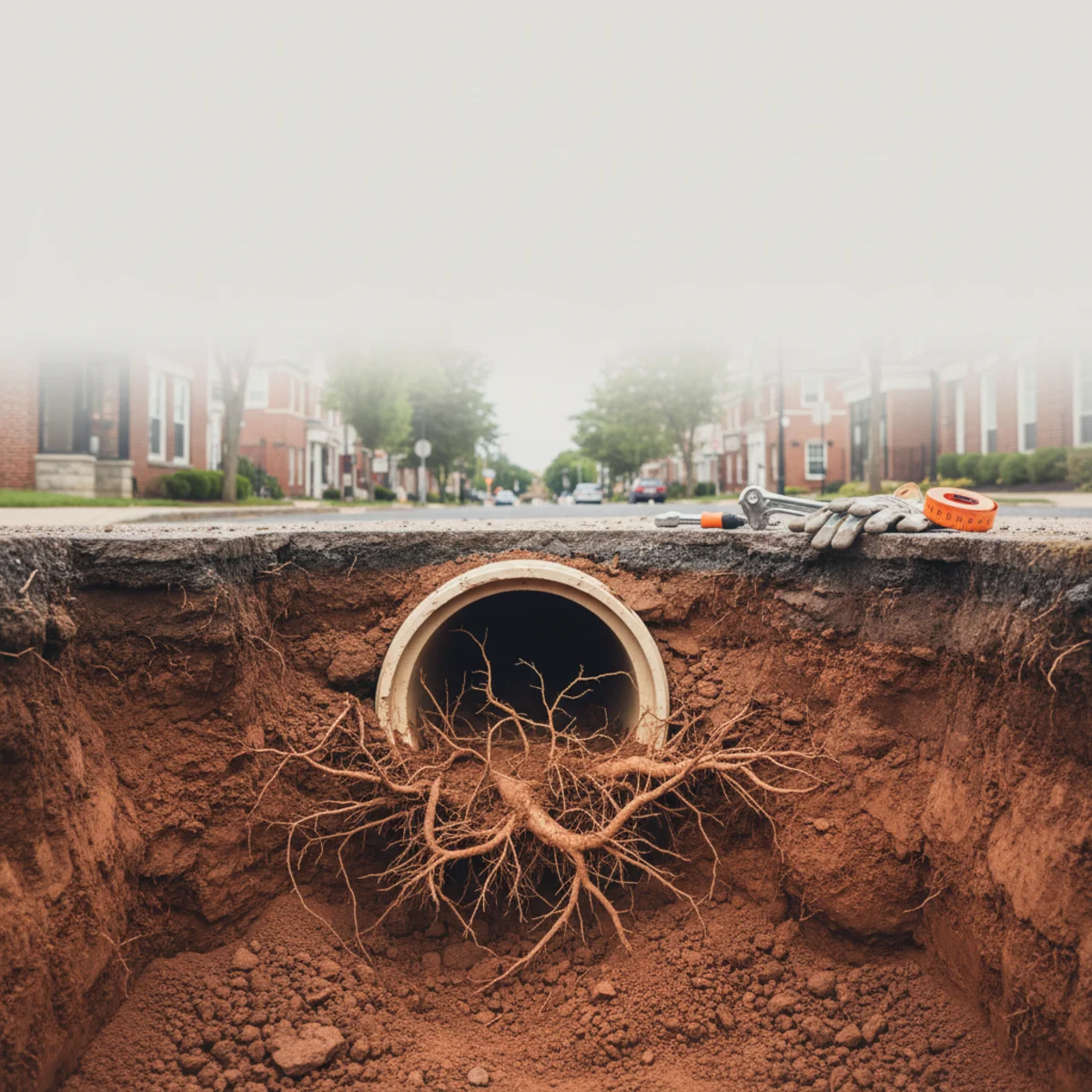
Those beautiful old street trees that shade Roselle Park are also the number-one enemy of its century-old sewer lines. Here is exactly how roots get into a pipe, why they keep coming back, and what stops them.
Key Takeaways
- Roots grow toward the water and nutrients your sewer leaks through a cracked joint.
- Old jointed clay pipe under most Roselle Park homes is a root's favorite target.
- A recurring clog that returns on the same yearly schedule usually means roots.
- Mechanical or jet clearing buys months, not permanence, because the outside root keeps regrowing.
- Stopping roots for good means sealing or replacing the pipe, decided after a camera, not before.
Why Roots Go Straight for Your Sewer
Tree roots are not random wanderers. They grow toward what they need, and what a tree needs most is water and nutrients. Your sewer line carries a steady supply of both, warm and constant, right past the root zone.
A healthy, sealed pipe gives roots nothing. But the moment a joint loosens or a hairline crack opens, a little water vapor escapes into the surrounding soil. To a root, that is a dinner bell. It grows toward the moisture, finds the tiny opening, and pushes a thread-thin tip inside.
Once inside, the conditions are perfect — nutrient-rich water, no competition, no drought. The root explodes into a dense mass of fine hairs that fills the pipe like a net. Everything you flush gets caught in it.
In Roselle Park, this is one of the most common sewer problems we see, and the reason is geography. The borough is lined with mature street trees, and many homes still run on original clay or early cast-iron laterals with joints every few feet. Big old trees plus old jointed pipe is the exact recipe for root intrusion, which is why rooter service stays busy here year-round.
Old Clay Pipe Is a Root's Favorite Target
Not all sewer pipe is equally vulnerable, and the kind under a lot of Roselle Park homes is the worst case.
Clay pipe — vitrified clay tile — was the standard for decades and was laid in short sections with a joint at every connection. Those joints were originally sealed with mortar or other materials that age, shrink, and crack. Every joint becomes a potential doorway, and a single lateral can have dozens of them. Clay is also brittle; ground shift cracks it.
Early cast iron is better but not immune. It corrodes from the inside over decades, and as the wall thins and joints weaken, the same openings appear.
Modern PVC is laid in long glued runs with far fewer joints and a smooth, sealed interior, so it resists roots much better. But most of Roselle Park's housing predates PVC by half a century.
The practical upshot: if your home is old and has never had its sewer lateral replaced, assume it is jointed clay or aging cast iron and assume roots are interested. A camera sewer inspection confirms the pipe material and shows exactly where roots have already found a way in — the only way to know for sure without digging.
The Warning Signs Before the Backup
Root intrusion is gradual, which means it warns you — if you know the signals.
The earliest sign is often a recurring clog that always comes back in the same timeframe. Roots grow slowly, so a root-blocked line will clear and then re-block over weeks or months in a frustrating, predictable cycle. If your sewer needs clearing on roughly the same schedule every year, suspect roots.
Gurgling toilets and slow drains across multiple fixtures come next, as the root mass narrows the pipe and disrupts flow. You may notice the toilet bubbling or draining oddly before anything else.
Many people also notice it seasonally. Roots grow most actively in the warmer months, so a line that backs up every spring or summer is often following the root growth cycle.
The sign you do not want to reach is the full backup — sewage surfacing in the basement floor drain or the lowest toilet. That is the root mass finally closing the pipe completely. Catching it at the recurring-clog stage means a routine clearing; catching it at the backup stage means a sewer backup cleanup on top of the clearing. The signs give you a head start — use it.
Clearing Roots: What Works and What Doesn't
When roots are in the line, clearing them is step one — but how you clear them matters.
A mechanical rooter — a cable with a spinning cutting head — shears the root mass out of the pipe and restores flow. It is the standard first response and it works. The honest catch: cutting roots is like mowing a lawn. You remove what is in the pipe, but the root outside the pipe is still alive and growing back. Mechanical clearing buys you months, not permanence.
Hydro jetting does a more thorough job. High-pressure water with a root-cutting nozzle shears the roots and flushes the debris completely, leaving a cleaner pipe wall than a cable does. On a heavily invaded line, hydro jetting is often the better clearing because it gets more of the mass and slows the regrowth.
What does not work: store-bought foaming root killers as a standalone fix. They can slow regrowth at the entry point as part of a maintenance plan, but they do not clear an established mass, and they are no substitute for mechanical or jet clearing.
And nothing you pour or cut changes the fundamental issue — the pipe still has the opening that let the roots in. Clearing treats the symptom. To stop the cycle, you have to address the pipe.
Slowing Roots Down While You Decide
Replacing a sewer lateral is a real project, and not everyone is ready to do it the week they learn roots are in the line. Between clearings, a few measures genuinely slow regrowth and buy time.
Foaming root-control products are the most useful homeowner tool. Used on a schedule, a foaming herbicide that coats the top of the pipe kills root tips at the entry point without harming the tree itself. It does not clear an existing mass — that still needs mechanical or jet clearing first — but applied after a clearing, it stretches the time before the next blockage. Follow the label and keep it to products made for sewer use.
Mind your planting too. If you are putting in new trees or shrubs, keep the aggressive, water-seeking species — willows, silver maples, poplars — well away from the sewer lateral's path. You cannot move the century-old street trees, but you can avoid adding new offenders right over the pipe.
And keep a clearing schedule. A line with known root intrusion that gets cleared on a planned interval rarely backs up; a line that gets ignored until it floods always picks the worst possible moment. A standing sewer cleaning appointment turns an emergency into routine maintenance while you plan the permanent fix on your own timeline.
Stopping Roots for Good Means Fixing the Pipe
Here is the part nobody wants to hear but everybody should: if roots keep coming back, the permanent fix is the pipe, not another clearing.
Roots return because the crack or open joint that let them in is still there. As long as that opening exists, you are signing up for clearing the line on a schedule forever. For some homeowners, a managed maintenance plan — periodic clearing plus root treatment — is a reasonable way to live with an old line for a while, and that is an honest option, not a failure.
But when the intrusion is severe or the pipe is cracked and offset along its length, replacing or relining the damaged section is what actually ends it. Trenchless sewer repair can sometimes line the old pipe from the inside with minimal digging, sealing the joints roots used. A full sewer line replacement swaps brittle jointed clay for smooth, fused PVC that roots cannot easily enter. I will tell you straight that trenchless is not always cheaper or even possible — it depends on the pipe's condition — and that decision should follow a camera inspection, not precede it.
If your Roselle Park sewer line backs up on a schedule, call (207) 419-2600. We clear it, camera it, and lay out the real options — manage it or fix it — so you choose with the full picture. Homes across Roselle Park fight this same battle with the same old trees, and there is a right answer for your specific line.
Frequently Asked Questions
Keep Reading
Drain & Sewer
How to Unclog a Toilet Without a Plunger (Safely)
The plunger is missing and the bowl is full. Before you panic or pour something dangerous, try these safe home methods — and learn the bright line for when to stop and call a plumber.
7 min read · March 2, 2026

Drain & Sewer
Sewer Smell in the House? Work Through This Diagnosis Ladder
That sewer-gas smell has a source, and you can often find it by working from the simplest cause to the most serious. Here is the diagnosis ladder a plumber runs in their head, top rung to bottom.
8 min read · February 9, 2026

Drain & Sewer
Why a Camera Sewer Inspection Is the Smartest Plumbing Money You Spend
You would not buy a car without looking under the hood. A camera sewer inspection is how you look inside the one pipe you cannot see — before you dig, before you buy an older home, before a clog becomes a flood.
7 min read · January 26, 2026