Emergency
How to Shut Off the Water Main in a Roselle Park Home
8 min read · Published September 15, 2025
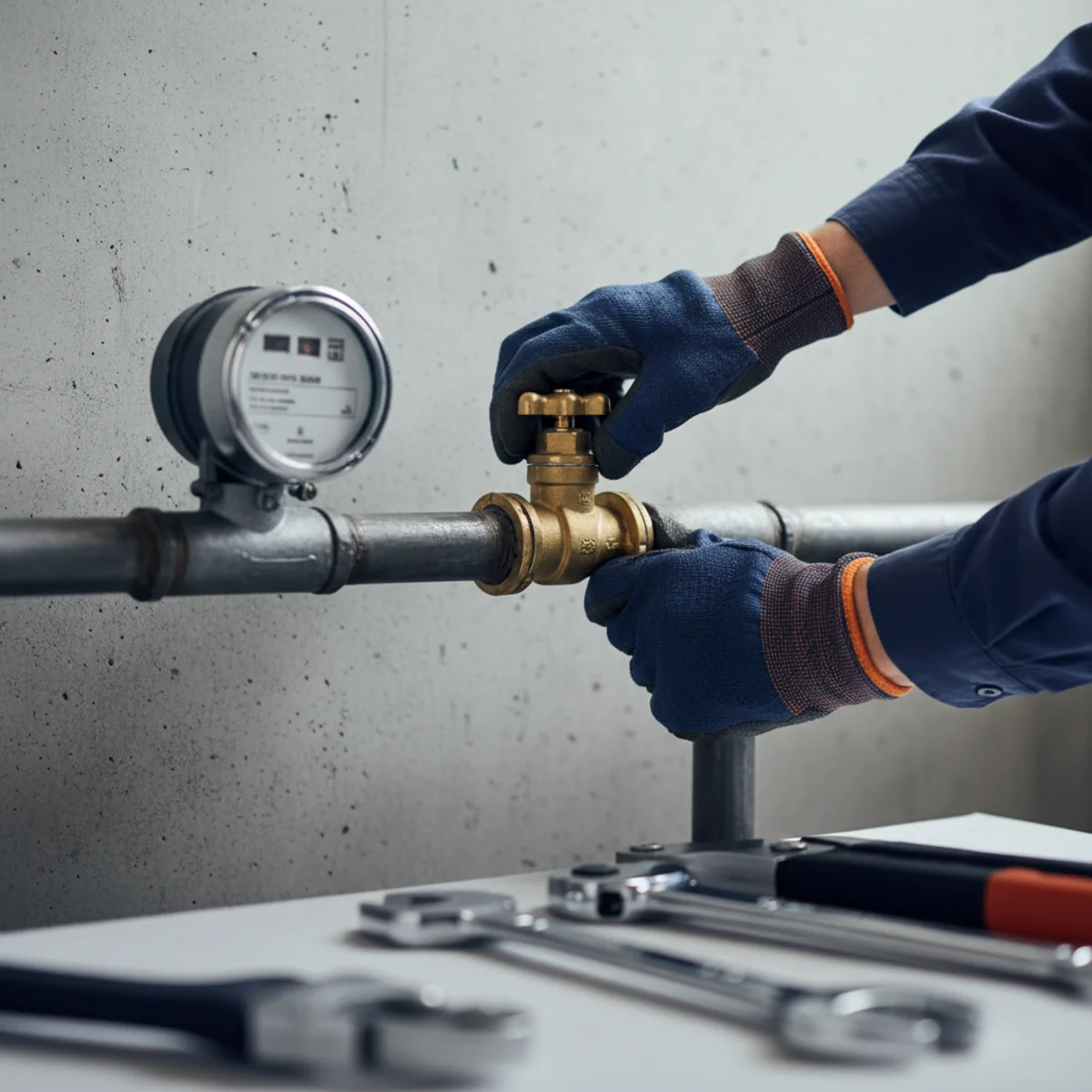
The main shutoff valve is the most important fifteen square inches of your house, and most owners have never touched it. Here is where Roselle Park homes hide it and how to use it.
Key Takeaways
- Find the main shutoff before you need it, usually on the street-facing wall near the meter.
- Know your valve: a round-wheel gate valve seizes with age; a lever ball valve closes in a quarter turn.
- Confirm the seal by opening a tap, the flow should die to a trickle within seconds.
- If an old gate valve resists, stop, never force it with a wrench or cheater pipe.
- Test the valve twice a year with the clock changes to keep the stem from seizing.
Why This Valve Outranks Every Tool You Own
Every plumbing emergency in your house — burst pipe, failed water heater, split washer hose — has the same first move: close the main shutoff. Not towels, not buckets, not a frantic scroll for a plumber's number. The valve.
A home's supply system can push out several gallons a minute through a real break. The difference between an owner who knows the valve and one who does not is measured in inches of basement water and weeks of drying. Insurance adjusters can usually tell from the damage how long the water ran.
And yet the main shutoff is the least-visited spot in the house. Plenty of Roselle Park homeowners we meet have lived a decade above a valve they have never turned. Some inherited a valve painted into the wall decades ago. Some are renting and were never shown.
This guide fixes that in one read: where the valve lives in this borough's housing stock, which of the two valve types you have, how to operate it, and the one situation where you should stop and not force anything.
Where Roselle Park Basements Hide the Shutoff
Roselle Park makes this search easier than most towns, for one good reason: nearly every house here has a basement, and the main shutoff almost always lives where the water service enters it.
Start at the wall facing the street. The service line comes from the water main under the road, through the foundation, and straight to your water meter. The main shutoff valve sits on that pipe — usually just before the meter, sometimes one on each side of it. If you can find the meter, you are within arm's reach of the valve.
In the borough's early-1900s two-story frames and colonials, look low on the front foundation wall, often behind stairs, shelving, or fifty years of stored boxes. In houses with later additions, the entry point can be offset toward a corner. Finished basements hide the valve behind an access panel — and if your finished basement has no panel, that is worth correcting before you need it.
No basement because you are in a slab-era addition or a converted space? Check the utility closet, the garage wall nearest the street, or the crawl space access. The rule holds: follow the meter.
Gate Valve or Ball Valve: Know Which One You Have
Two valve types cover nearly every home here, and they behave very differently under stress.
A gate valve has a round wheel handle, like a small steering wheel. Inside, a metal gate screws down across the flow. They were standard for most of the twentieth century, so the borough's older homes usually have one. They close with multiple full turns clockwise — and they are the valve most likely to fail you. Decades of sitting untouched lets corrosion freeze the stem; the classic failures are a wheel that spins without grabbing, a stem that snaps, or a gate so scaled it never fully seals.
A ball valve has a straight lever handle. Inside, a drilled ball rotates a quarter turn. Lever in line with the pipe means open; lever across the pipe means closed. They close fast, seal hard, and rarely seize. Every modern repair or repipe installs one, which is why newer renovations have them.
Go look at yours today. If you find a gate valve from the original plumbing, plan to operate it gently — and read the section below about what to do when an old valve will not move.
Closing It, Step by Step
Here is the whole procedure, calm and in order:
- Clear your access. You want a real grip, not a fingertip reach over boxes.
- Gate valve: turn the wheel clockwise, hand-tight, multiple turns until it stops. Do not muscle the last fraction with a wrench — a snug stop is closed.
- Ball valve: pull the lever a quarter turn until it sits crossways to the pipe. Done.
- Confirm. Open a cold tap at a sink. Strong flow that dies to a trickle within seconds means the valve sealed. Flow that keeps running means it did not.
- Drain down if you are fighting a leak: open a faucet at the bottom of the house and one upstairs, and let the standing water in the pipes empty at a sink instead of through the break.
Reopen slowly when the time comes — a quarter turn at a time on a gate valve, gentle on the lever of a ball valve — so the rush of returning water does not hammer the pipes.
Total time once you know the routine: under two minutes. That is the entire skill.
If the Valve Will Not Turn — Stop
Here is where homeowner damage usually happens, so this section is blunt.
An old gate valve that resists is not a challenge; it is a warning. Forcing it with a wrench or a cheater pipe for extra grip is how stems snap and how a stuck-open valve becomes a leaking one — and a leak at the main shutoff cannot be isolated by any other valve in your house. You would turn a contained problem into the worst version of itself.
If moderate hand pressure will not move it, leave it and use plan B: the curb stop, covered in the next section, or the fixture-level valve closest to your actual leak.
Then get the valve replaced on a normal schedule. A seized main shutoff is a real defect, not a quirk — it means your house currently has no brakes. Swapping a tired gate valve for a quarter-turn ball valve is routine water line work, it gets coordinated with a brief curb-side shutoff, and it permanently removes the scariest unknown in your basement.
A valve that only might work is not the tool you want attached to an emergency.
The Curb Stop: The Backup You Do Not Operate
There is a second shutoff for every house: the curb stop, buried at the property line under a small metal cap marked W, usually in the lawn strip or near the sidewalk edge.
This valve closes the service line between the street main and your house — upstream of your basement valve. When the inside valve is seized or the leak is on the service line itself, the curb stop is what actually stops the water.
Here is the honest part: it is not yours to operate. The curb stop generally belongs to the water utility, it takes a long-handled key you do not own, and an old one can be just as seized as your basement gate valve — except breaking this one can knock out your service entirely and put the repair in the street. Homeowners cranking on curb stops with vise grips is how small emergencies grow into excavations.
What you should do is know where yours is. Find the cap, clear the grass off it, and point it out when help arrives. If your inside valve fails during an active leak, say exactly that when you call (207) 419-2600 — a crew that knows the curb stop is the plan brings the key and the main line experience to use it properly.
Test It Twice a Year — Before the Emergency Does
A shutoff valve you have never operated is a rumor, not a safety system. The fix costs five minutes twice a year.
Put it on the calendar with the clock changes: close the main fully, confirm a faucet dies to a trickle, then reopen it slowly. This does two jobs at once — it proves the valve works, and the motion itself keeps the stem from seizing. Gate valves especially live longer when they get exercised.
While you are down there, make the valve findable under stress. Tag it with a bright label. Clear the boxes. Show everyone in the house, including teenagers and tenants — emergencies do not check who is home. Renters in the borough's two-family houses should ask their landlord to walk them to it; that is a reasonable ask, not a bother.
For everything past the valve — the burst pipe the shutoff just contained, the corroded line it revealed, the replacement it needs — emergency plumbing help anywhere in Roselle Park is one call away, day or night. But the valve is yours. Knowing it cold is the cheapest insurance in the house.
Frequently Asked Questions
Keep Reading
Emergency
What to Do When a Pipe Bursts in Your Roselle Park, NJ Home
A burst pipe dumps water fast, and the first ten minutes decide how bad the damage gets. Here is the exact order of moves for a Roselle Park home — shutoff, power, photos, then the call.
8 min read · January 12, 2026
Emergency
Why Water Leaks Get Worse Overnight
That drip you noticed at dinner really is worse by breakfast, and it is not your imagination. Night brings higher water pressure, colder pipes, and eight unwatched hours. Here is the mechanics.
8 min read · December 8, 2025
Emergency
How to Handle an Emergency Plumbing Leak: A Triage Guide
Every active leak gets handled the same way: identify what kind it is, stop the water, contain the spread, and give dispatch the right details. Here is the triage order that works.
8 min read · November 3, 2025