Emergency
How to Handle an Emergency Plumbing Leak: A Triage Guide
8 min read · Published November 3, 2025
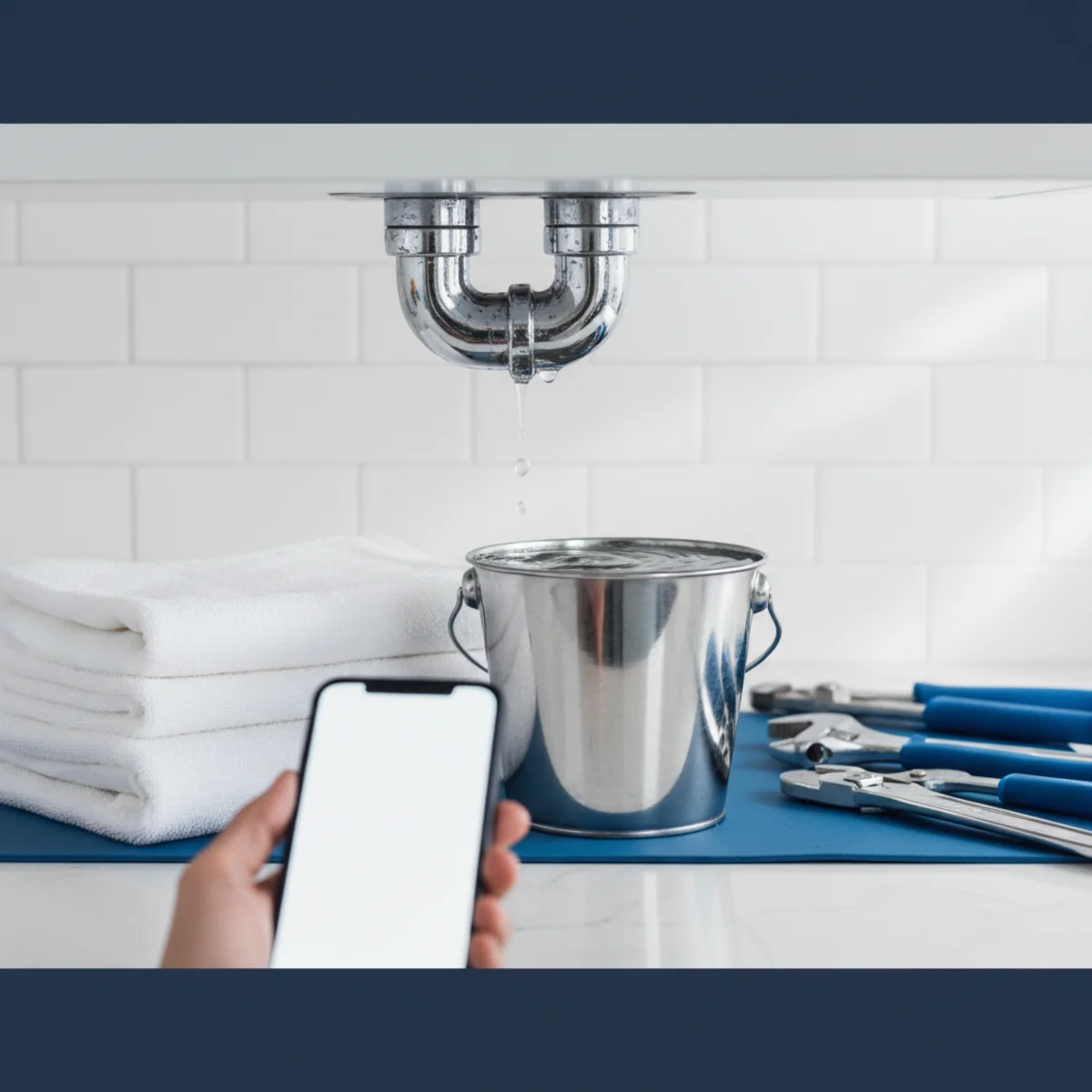
Every active leak gets handled the same way: identify what kind it is, stop the water, contain the spread, and give dispatch the right details. Here is the triage order that works.
Key Takeaways
- Identify supply versus drain first: supply leaks spray under pressure, drain leaks only run when a fixture is used.
- Stop a supply leak at the closest working valve, then fall back to the main if the stop is seized.
- Trace where water already traveled with a flashlight before deciding the leak is small.
- Tell dispatch whether water is stopped, where it is, and any electrical contact.
- Gas, sewage, and bulging ceilings are never homeowner triage; leave and call a pro.
First, Figure Out What Is Actually Leaking
Not all leaks are the same animal, and the first thirty seconds of looking saves the next thirty minutes of panic.
Ask one question: is this water coming from a supply pipe or a drain? Supply leaks spray, hiss, or run steadily, because those pipes sit under constant pressure. Drain leaks only show up when something is being used — the sink runs, the tub empties, the washer drains — and stop when the fixture stops.
The answer changes your whole response. A supply leak will not quit until you close a valve. A drain leak quits the moment you stop putting water down it.
There is a third category that outranks both: anything coming up out of a drain instead of leaking down from a pipe. Gray or brown water rising in a tub, floor drain, or basement toilet is a sewer problem, not a leak, and it means stop using water entirely — every flush upstairs ends up on your basement floor. That one goes straight to the phone.
Look, identify, then act. The order matters.
Stop the Water at the Closest Valve That Works
For a supply leak, work from the fixture outward.
Leaking toilet or faucet? There is a small oval-handled stop valve on the wall or floor below it. Turn it clockwise until snug. Leaking washing machine hose? The valves sit in a box behind the machine. Water heater leaking? The cold-side valve on top of the tank shuts off its feed.
If the fixture stop is seized, painted over, or missing — common in older Roselle Park houses — skip it and head for the main shutoff next to the water meter, low on the wall nearest the street in most homes here. Do not stand there fighting a corroded stop valve while the floor fills.
Drain leaks need no valve at all. Stop using the fixture, put a bucket under the drip, and the emergency mostly pauses itself. That is worth knowing at 11 PM: a leaking trap under the kitchen sink is contained by an empty bucket and a closed cabinet door until morning.
Every valve you cannot find tonight is a valve worth labeling this weekend.
Contain the Spread Without Making It Worse
Once the water is stopped or slowed, think about where it has already traveled.
Water is sneaky. It runs along the underside of pipes and joists, follows wires, and drops far from the actual leak. Trace the wet path with a flashlight before deciding the leak is small — the drip you see in the hallway may start ten feet away above the kitchen.
- Towels at the edges of the puddle keep it from reaching walls and carpet.
- A bucket catches the drip; a cookie sheet catches a wide slow one.
- Move electronics and anything made of particle board — that stuff swells in an hour.
- If water is coming through a light fixture, do not touch the switch. Cut that circuit at the panel.
- Open the cabinet or vanity doors under a leak so air keeps the wood from cupping.
Resist tearing into drywall to chase the leak yourself. Opening walls is sometimes necessary, but doing it in the right spot once beats three exploratory holes — and finding that spot is what leak detection equipment is for.
What Dispatch Actually Needs to Know
When you call (207) 419-2600, you are not bothering anyone — you are giving dispatch the facts that decide how fast a truck moves. Five details do most of the work:
- Is the water stopped, slowed, or still running? This single answer sets the priority.
- Where is the leak — which room, which floor, visible pipe or inside a wall or ceiling?
- Supply or drain — does it run constantly or only when something is used?
- Any electrical contact — outlets, fixtures, the panel?
- What kind of building and where — a multifamily near the train station gets different questions than a single-family on a side street.
Describing the issue clearly by phone means the truck arrives stocked for your actual problem instead of discovering it on site. Emergencies are prioritized and you get a clear ETA before the truck rolls — no fake countdown, just a straight answer about when help arrives.
If you are a tenant, call the landlord too, but do not wait on them to stop active water. Closing a valve to protect the building is always the right move.
What Not to Do While You Wait
The waiting period is where small leaks become big stories. A few honest do-nots:
Do not turn the water back on to test it. The break did not heal. Every test run adds gallons to your cleanup.
Do not crank the heat to dry things out fast. Warm and damp is exactly what mold likes. Moving air dries; heat alone just incubates.
Do not pour chemical drain cleaner at a leak that involves a drain line. If the trap or joint is already compromised, you now have a caustic leak instead of a water leak, and the plumber has to handle the piping wearing gloves.
Do not stack towels and call it handled if the leak is inside a wall or ceiling. Hidden cavities hold water you cannot mop. They need to be opened and dried, or they quietly rot the framing.
And do not talk yourself out of the call because the drip slowed. Leaks pulse with household pressure — slower at the moment does not mean fixed. It usually means the next surge has not arrived yet.
After the Fix: Make the Leak Explain Itself
A good repair answers two questions: what broke, and why.
The why is the part homeowners skip. A pinhole in copper might be a one-off — or the first of many, because the same water chemistry is working on every inch of that line. A failed supply hose on a washer means its twin on the other side is the same age. A leaking trap that was hand-tightened by the last handyman tells you what else to double-check.
Ask the plumber to show you the failed part and say plainly whether this is an isolated fix or a symptom. In Roselle Park housing stock, where original galvanized supply lines and aging fittings are still common, that conversation sometimes leads to a bigger but honest answer: one more patch is cheap, but the third patch on the same run is money thrown at a pipe that is telling you it is done.
This is also the moment to map your shutoff valves while someone who finds them daily is standing in your basement. Two minutes of pointing saves you a flooded floor next time.
Leaks You Should Never Triage Yourself
Most water leaks are safe for a homeowner to stop, contain, and wait out. Three situations are not.
Gas. If you smell gas near any appliance, skip every step above — do not flip switches, do not phone from inside. Leave the house, then call from the sidewalk. Water can wait an hour; gas cannot wait a minute.
Sewage. Anything rising from drains carries bacteria your shop vac and sneakers should not meet. Stop water use, keep kids and pets away, and let a pro handle both the blockage and the cleanup.
Ceiling bulges below a bathroom. A drywall belly full of water can drop forty pounds of soggy ceiling without warning. Clear the room and let it be drained in a controlled way.
For everything else — the spraying supply line, the drip through the floor, the mystery puddle that comes back every morning — the playbook in this guide holds, and emergency plumbing help is one call away around the clock. Triage stops the damage. The repair makes it stay stopped.
Frequently Asked Questions
Keep Reading
Emergency
What to Do When a Pipe Bursts in Your Roselle Park, NJ Home
A burst pipe dumps water fast, and the first ten minutes decide how bad the damage gets. Here is the exact order of moves for a Roselle Park home — shutoff, power, photos, then the call.
8 min read · January 12, 2026
Emergency
Why Water Leaks Get Worse Overnight
That drip you noticed at dinner really is worse by breakfast, and it is not your imagination. Night brings higher water pressure, colder pipes, and eight unwatched hours. Here is the mechanics.
8 min read · December 8, 2025
Emergency
Signs You Need a 24 Hour Plumber (And What Can Wait Until Morning)
Some plumbing failures cost you real money every hour they wait, and some just feel that way at midnight. Here is an honest sorting of what needs a 24 hour plumber tonight.
8 min read · October 7, 2025