Kitchen & Bath
Garbage Disposal Not Working? Safe Fixes Before You Call
7 min read · Published December 1, 2025
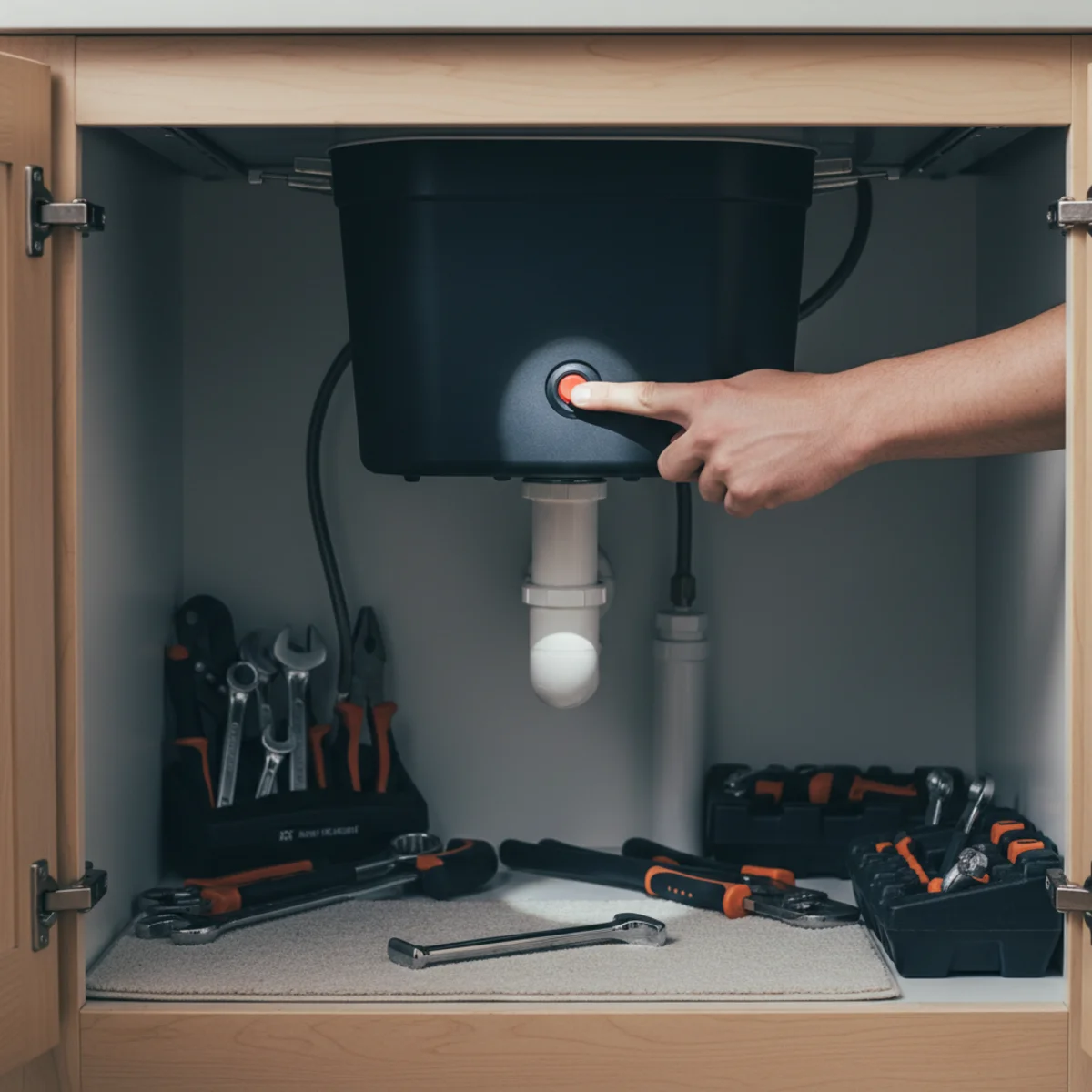
A dead or jammed garbage disposal usually has a simple, safe fix you can do yourself — if you know which sound means what. Here is the homeowner playbook, and the one rule you never break.
Key Takeaways
- Never reach into a disposal, even unplugged — stored torque can lurch it and break a finger.
- Dead silent? Press the red reset button on the bottom of the unit and check the breaker.
- Humming but not spinning means a jam — kill the power, then free it with the hex key underneath.
- Run cold water before, during, and after grinding to keep fats solid and flush them through.
- A leak from the bottom of the housing means the internal seals failed; replace the unit.
The One Rule: Never Put Your Hand In There
Before anything else, the rule that matters most: never reach into a garbage disposal. Not to clear a jam, not to fish out a spoon, not even when it is unplugged and you are sure it is off.
The shredding mechanism inside is not a spinning blade like people picture — it is a pair of blunt impellers and a serrated ring — but it does not need to be sharp to break a finger or worse. Disposals can hold stored torque, and a unit you think is dead can lurch when the jam frees. People have been badly hurt clearing a disposal by hand.
Everything below can be done with the power off and a tool in your hand, never your fingers. If a problem truly requires reaching into the chamber, that is the point where you stop and call a professional.
Keep that rule front of mind and the rest of this is straightforward. Most disposal problems are one of three things, and two of them you can fix in five minutes without spending a dollar.
Step One: Reset the Disposal
If you flip the switch and the disposal does nothing — no hum, no buzz, dead silence — the most likely cause is the simplest. The unit's internal overload tripped and shut it down to protect the motor, and it just needs a reset.
Look underneath the disposal, on the bottom of the unit inside the sink cabinet. There is a small red or black button — that is the reset. If it has popped out, the unit has tripped. Press it firmly back in until it clicks and stays. Wait a minute for the motor to cool, then try the switch again.
If the reset will not stay pressed in, the motor is still too hot or the overload keeps tripping for a reason — usually a jam that needs clearing first.
No reaction at all even after a reset? Check the obvious before assuming the worst. Make sure the unit is plugged in under the sink, and check your breaker panel for a tripped breaker on the kitchen circuit. A disposal that shares a switch with the dishwasher can also be fooled by a bad switch. If power is reaching it and the reset holds but it still does nothing, the motor may be done.
Step Two: Free a Jam With the Hex Key
If you flip the switch and the disposal hums or buzzes but the grinding plate will not turn, it is jammed. Something is wedged between the impeller and the housing. Do not hold the switch on — a humming disposal that cannot turn will overheat and trip in seconds, and running it jammed can burn out the motor.
Turn the switch off. Then find the hex key — that little L-shaped wrench that came with the disposal, often clipped to the underside of the unit or in a kitchen drawer. On the very bottom center of the disposal is a hex-shaped socket. Fit the key in and crank it back and forth, both directions. You are manually rotating the plate to break whatever is wedged loose. You will feel it free up.
No hex key? A quarter-inch hex wrench from any hardware store fits. Once it spins freely by hand, shine a flashlight down into the disposal from above and use tongs or pliers — never fingers — to pull out whatever caused the jam. Then hit the reset button, run cold water, and test the switch.
What Jams and Kills Disposals in the First Place
Disposals are tougher than the things people feed them, but a few items wreck them reliably, and avoiding these is most of disposal care.
- Fibrous and stringy waste — celery, corn husks, artichokes, onion skins — wraps around the impeller and binds it.
- Starchy expanders — potato peels, rice, and pasta — turn to paste, coat the chamber, and clog the drain below it.
- Grease and fat poured down warm, which cools into a solid plug in the trap and the branch drain.
- Coffee grounds and eggshells, which build up into a sand-like sludge.
- Bones, fruit pits, and hard shells, which jam the plate instantly.
- Anything non-food — bottle caps, twist ties, a stray fork — the classic jam.
The simplest habit that saves disposals: run a strong stream of cold water before, during, and for fifteen seconds after grinding, and feed waste in gradually rather than packing the chamber full. Cold water keeps fats solid so they grind and flush instead of coating the pipe. Done right, a disposal rarely jams, and the drain underneath stays clear of the buildup that otherwise turns into a clogged sink.
Leaks, Smells, and the Drain Below
Sometimes the disposal runs fine but causes other trouble, and that points the diagnosis in a different direction.
A leak under the disposal has a few usual sources. Water dripping from the top, where the disposal meets the sink flange, means the mounting seal or the plumber's putty has failed and the unit needs to be dropped and re-sealed. A leak from the side, where the dishwasher hose or the drain pipe connects, is usually a loose clamp or a worn gasket. A leak from the very bottom of the unit is the worst case — that means the internal seals have failed and the disposal itself is at the end of its life.
A persistent smell, on the other hand, is rarely the disposal failing. It is food residue caught in the grinding chamber and under the rubber splash baffle. Grinding ice cubes and a handful of citrus peel scours the chamber, and lifting and scrubbing the baffle clears the part most people forget. If the smell is more of a sewer odor than a food odor, the problem may be the drain past the disposal, not the unit itself.
When the Disposal Is Simply Done
Disposals do not last forever, and there is a point where replacing beats repairing every time.
If you press the reset, confirm power is reaching the unit, and it still makes no sound and will not hum, the motor has likely burned out. Motors are not worth rebuilding on a disposal — the unit is replaced. The same is true if the bottom of the housing is leaking, because that is an internal seal failure with no field fix.
Age matters too. A disposal that has run for a decade-plus and now jams constantly, hums weakly, or leaks is telling you it is worn out. Throwing a new flywheel or a re-seal at a tired motor is good money chasing bad.
Replacement is a clean, contained job — disconnect, unmount, mount the new unit, reconnect the drain and the dishwasher line, test for leaks. We handle it as part of our garbage disposal repair work, match the new unit to your sink and household, and check the trap and drain while we are under there. When you are ready, call (207) 419-2600 and we will sort out repair versus replace before charging into anything.
When to Stop and Call a Pro
Here is the clean line. You can safely handle the reset button, the hex-key jam clear, removing visible debris with tongs, and basic odor cleanup. Those are real fixes that solve most disposal calls without a plumber.
Call a professional when there is any electrical question — the unit is hardwired, the breaker keeps tripping, or you are not comfortable confirming power. Call when the disposal leaks from the bottom or the mounting, when it is jammed by something you cannot reach with tongs from above, when it backs up into the sink along with the dishwasher, or when it simply will not run after a reset and a power check.
And never, under any circumstances, reach into the chamber or take the disposal apart while it is connected to power.
When you call (207) 419-2600, tell us what it is doing — silent, humming, leaking, or backing up — because each one means a different fix and a different part on the truck. We cover Roselle Park and the neighboring towns, give a straight arrival window, and leave the cabinet dry.
Frequently Asked Questions
Keep Reading
Kitchen & Bath
Toilet Keeps Running? The Step-by-Step Fix You Can Do Yourself
A toilet that runs and runs is wasting water by the hundreds of gallons, and the fix is almost always a cheap part you can replace yourself. Here is the diagnosis ladder, from the easiest cause to the one that needs a plumber.
8 min read · April 6, 2026
Kitchen & Bath
Bathroom Plumbing Warning Signs You Shouldn't Ignore
A bathroom rarely fails all at once. It warns you first — a stain on the ceiling below, a floor that gives underfoot, drains that all slow together. Here is how to read those signals before they become a repair you cannot ignore.
8 min read · March 23, 2026

Kitchen & Bath
Kitchen Plumbing Upgrades to Make Before the Cabinets Go In
The rough-in is the one part of a kitchen remodel you cannot redo once the cabinets and counters are in. Here are the plumbing decisions to lock down before the drywall closes, in a Roselle Park home.
9 min read · February 2, 2026