Basement & Pumps
What Causes Low Water Pressure in an Older Roselle Park Home
8 min read · Published February 16, 2026
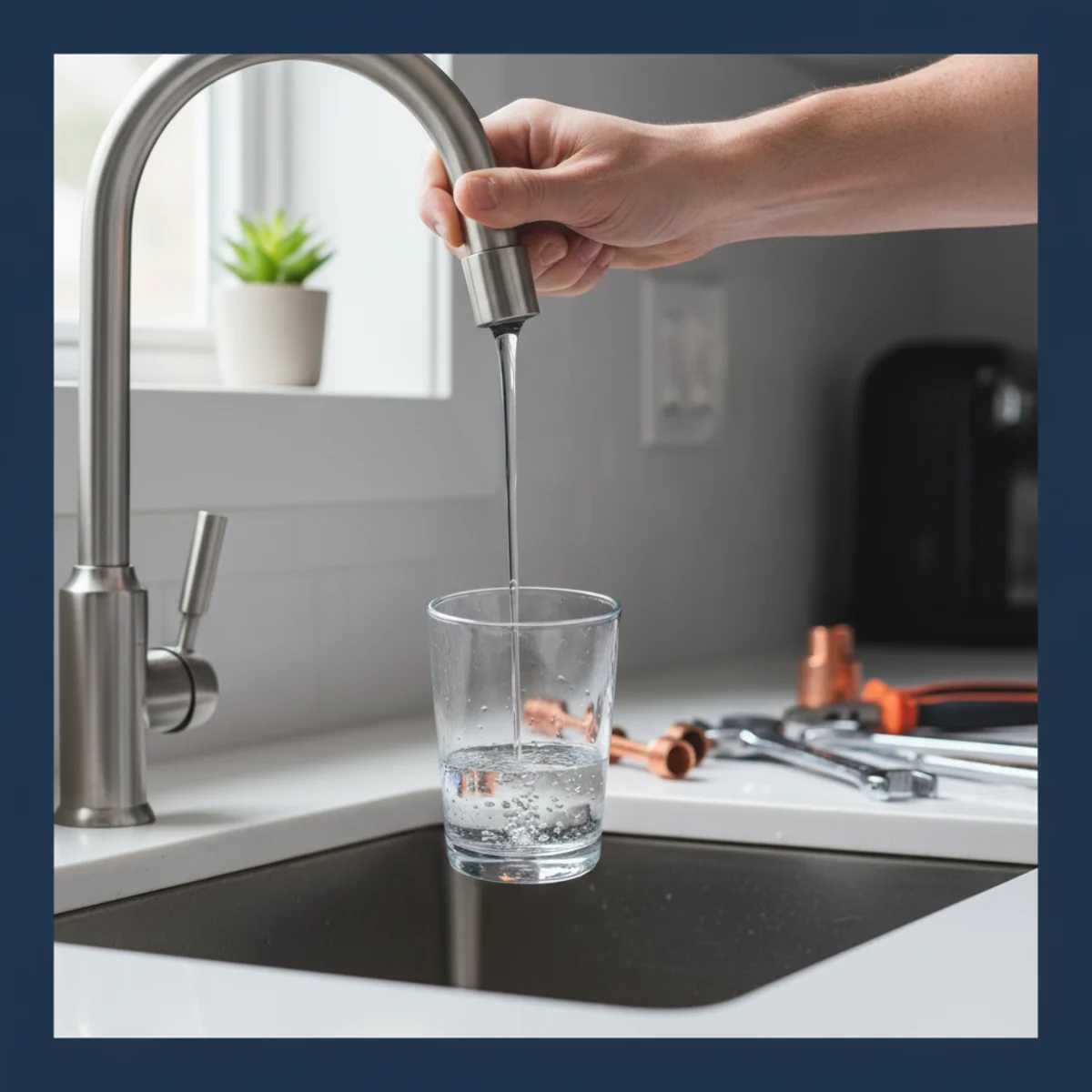
Low water pressure has a dozen causes, from a clogged aerator you can fix in five minutes to galvanized pipe closing up inside the walls. Here is how to tell which one you have.
Key Takeaways
- First split the problem: one weak fixture is local and cheap; whole-house is upstream and bigger.
- For a single slow tap, clean the aerator or showerhead and confirm the local shutoffs are fully open.
- Gradual whole-house loss in an older home is usually galvanized pipe corroded shut from the inside.
- A sudden whole-house drop points at a failed pressure reducing valve — check it with a gauge.
- Weak hot water but strong cold means sediment in the water heater, not the main supply.
First Question: One Fixture or the Whole House?
Before you blame the city or your pipes, answer one question, because it splits the whole problem in two: is the weak pressure at one fixture, or everywhere?
Walk the house. Try the kitchen sink, both bathrooms, the shower, the outside hose bib. If only one tap is weak, the trouble is local to that fixture, and the fix is usually cheap and quick. If every fixture is weak, the problem is upstream — somewhere between the street and where the water branches out to the house — and it is a bigger conversation.
This matters because the causes barely overlap. A single weak faucet is almost never a sign of a failing main line, and a whole-house pressure drop is almost never a clogged aerator. People waste money chasing the wrong one.
In Roselle Park's older housing stock, both kinds are common: mineral-clogged fixtures from years of hard-ish water, and decades-old galvanized supply pipe slowly closing up behind the plaster. Sort which one you have first, and the rest of the diagnosis follows.
When It's Just One Fixture
A single weak fixture is the good news scenario. Start with the easy stuff before you call anyone.
The aerator — the little screen on the tip of a faucet — clogs with mineral scale and grit and is the number-one cause of one slow tap. Unscrew it by hand or with pliers wrapped in a rag, rinse the debris out of the screen, and reinstall. That alone fixes a huge share of weak faucets.
A showerhead does the same thing. Mineral deposits block the spray holes. Soak it in white vinegar overnight or replace it.
If the aerator is clean and the fixture is still weak, check the small shutoff valves under the sink or behind the toilet — sometimes they got bumped partly closed. Make sure both hot and cold are fully open.
If cleaning the aerator and checking the valves does not bring a single fixture back, the issue is deeper in that fixture — a failing cartridge, a clogged supply line, or corrosion in the branch pipe. That is where faucet repair or a look at the local pipe comes in, but you have saved yourself a service call by trying the five-minute fixes first.
The Galvanized Pipe Problem
If the whole house lost pressure gradually over years, and your home dates to the early-to-mid 1900s like much of Roselle Park, the most likely culprit is galvanized steel supply pipe closing up from the inside.
Here is what happens. Galvanized pipe was standard for decades, and it corrodes internally. Rust and mineral scale build up on the pipe walls, year after year, narrowing the opening like plaque in an artery. A half-inch pipe can shrink to the diameter of a pencil. The water simply cannot get through at volume anymore.
The tell is that it is gradual and whole-house. Nobody notices day to day; they just realize the shower has not been strong in years. Hot lines often clog faster than cold because heat accelerates the scaling. Disturb the pipe and you may get a burst of rusty water as a chunk of scale breaks loose.
This is the honest part: you cannot clean galvanized pipe back to life. Once it has closed up, the fix is replacement — and patching one section just moves the restriction to the next. For a home that has reached this point, pipe replacement or a repiping conversation is the real answer, not another temporary patch.
The Pressure Reducing Valve and the Regulator Question
Many homes have a pressure reducing valve — a PRV — where the water line enters, usually a bell-shaped brass fitting on the main near the meter. Its job is to knock the street's high pressure down to a safe level for your house, around 50 to 60 psi.
PRVs wear out. When the internal parts fail, they often fail toward low, choking the whole house down to a trickle. A house that had fine pressure and then lost it across every fixture, fairly suddenly, with no other explanation, is a prime PRV suspect.
The diagnostic is a pressure gauge that screws onto a hose bib or laundry connection — a cheap tool. Normal is roughly 50 to 60 psi. Read low across the board and the PRV or the supply is the issue; read high, and a different problem is in play.
A failed PRV is a contained repair — replace the valve, restore the pressure. But it sits on the main line and sets pressure for the whole house, so it is worth getting right. If your gauge reads low everywhere and the pipe is not galvanized, the PRV is where I would look next.
Leaks, the Main Line, and the City's Side
Sometimes low pressure is a symptom of water escaping before it reaches your taps. A leak on the buried service line between the street and the house bleeds off pressure underground, and you feel it as weak flow inside.
The giveaway is when low pressure travels with other clues: a soggy patch in the yard, a water bill that climbed, the sound of running water in a quiet basement. If those line up, the pressure problem is really a water line problem, and chasing aerators will get you nowhere.
Then there is the city's side. Municipal pressure does drop sometimes — during high-demand periods, after a water-main break in the neighborhood, or following utility work. A quick way to check: ask a neighbor whether their pressure dropped too. If the whole block is weak, it is the utility, not your plumbing, and it usually resolves on its own.
A partially closed main shutoff or curb-stop valve, sometimes left that way after past work, also strangles the whole house. Confirm your main valve is fully open before assuming the worst. When the cause is not obvious, call (207) 419-2600 and we will measure the pressure and trace it to the real source.
Don't Forget the Water Heater Side
Here is a clue people misread constantly: low pressure on the hot side only. If your cold water is strong but the hot is weak everywhere, the problem is on the hot-water path, not the main supply.
The usual cause is the water heater. Sediment builds up in the bottom of a tank over the years — that gritty mineral layer that also makes the popping noises — and it can clog the heater's outlet and the nearby hot lines, throttling hot-water flow. Older galvanized hot lines, which scale faster than cold, make it worse.
A failed or partially closed valve on the hot outlet, or a clogged heat-trap nipple on top of the tank, can do the same thing.
The diagnostic is simple: compare hot and cold at the same fixture. Cold strong, hot weak, points you at the heater and the hot lines specifically. That narrows a whole-house mystery down to one system, which makes the water heater repair or hot-line fix far more targeted. If both hot and cold are equally weak, the heater is off the hook and the cause is upstream of it.
Working Through It in Order
Low water pressure feels vague, but it diagnoses cleanly if you go in order instead of guessing.
Start by splitting the problem: one fixture or the whole house. For one fixture, clean the aerator or showerhead and check the local shutoffs — that solves most single-tap cases for free. For a whole-house drop, compare hot versus cold to see whether the heater is involved, then put a pressure gauge on a hose bib to get a real number.
From there the suspects line up. Gradual, whole-house, older home: galvanized pipe. Sudden, whole-house, with a gauge reading low: the PRV. Low pressure plus a wet yard or a high bill: a buried leak. Whole block weak: the city.
The one thing not to do is throw parts at it. A new showerhead does nothing for galvanized pipe, and a PRV will not fix a clogged aerator. Match the fix to the cause.
When the simple checks do not land, that is the time to call (207) 419-2600. We will measure the actual pressure, find where it is being lost, and tell you straight whether it is a five-minute fix or a real pipe conversation — no upsell on equipment your house does not need.
Frequently Asked Questions
Keep Reading
Basement & Pumps
How to Prevent Basement Plumbing Backups in Your Roselle Park Home
A basement backup is the worst kind of plumbing failure — it comes up through the floor and it is not clean water. Here is how to stop it before it starts, and what your insurance actually covers.
8 min read · April 20, 2026

Basement & Pumps
Water Line Leak Warning Signs Every Roselle Park Homeowner Should Know
The water line from the street to your house can leak underground for weeks before you notice. These are the warning signs — soggy lawn, spinning meter, falling pressure — that catch it early.
8 min read · January 19, 2026
Basement & Pumps
7 Signs Your Sump Pump Is Failing Before It Quits for Good
A sump pump rarely dies without warning — it rattles, short-cycles, and rusts for months first. Learn the seven tells that mean yours is on the way out, before the next storm proves it.
8 min read · November 10, 2025