Water Heaters
Water Heater Repair vs Replacement: The Honest Framework
6 min read · Published October 13, 2025
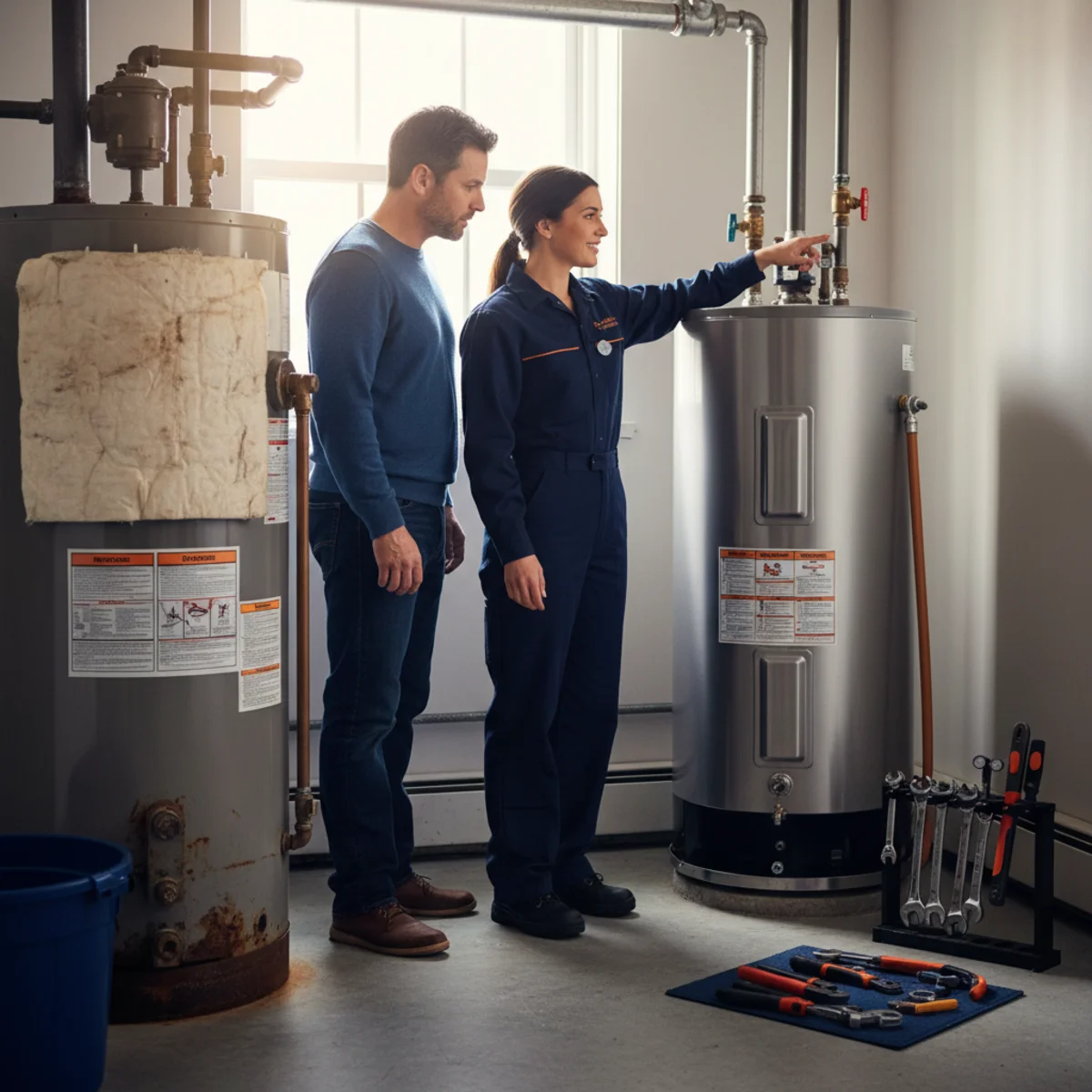
The repair-or-replace question is not a sales pitch when you do it honestly. It comes down to age, the type of failure, and what the part costs. Here is the math.
Key Takeaways
- The repair-or-replace call is a calculation of age, failure type, and part cost, not a gut feeling.
- Find the tank's age first; under eight repairs are worth it, over twelve you are on borrowed time.
- Bolt-on parts like elements, thermocouples, and valves are repair-friendly on a young tank.
- Any leak from the body or seam is terminal corrosion, no epoxy or clamp saves it.
- If a repair tops about half a new unit's price on an aging tank, replacement is the smarter spend.
The Question Everyone Gets Wrong
When a water heater acts up, most homeowners jump straight to one of two extremes. Either they assume any repair is throwing good money after bad and demand a new tank, or they cling to the old one and pour cash into it long past the point of sense.
Both are mistakes. The right answer is a calculation, not a gut feeling, and it is not the same for every house. A four-year-old tank with a bad heating element is a different situation than an eleven-year-old tank doing the same thing, even though the symptom looks identical.
The framework below is the one I actually use in Roselle Park basements. It rests on three numbers: the age of the tank, the type of failure, and what the fix costs relative to a replacement. Get those three straight and the decision usually makes itself. When it does not, that is exactly when a phone call to (207) 419-2600 is worth more than another hour of internet research.
Variable One: How Old Is the Tank?
Age is the single most important number, so find it first. Most tanks carry a manufacturer sticker with a date, or a serial number where the first digits encode the year. If you cannot read it, a plumber can decode it in seconds.
Here is the rule of thumb. A standard tank water heater lasts eight to twelve years. Under eight, the tank itself has plenty of life and repairs are almost always worth it. Over twelve, you are on borrowed time and every dollar of repair is a gamble against a tank that could leak next month.
The eight-to-twelve window is the gray zone where the other two variables decide. In Roselle Park, where a lot of basements run a bit damp and the water is moderately hard, tanks tend to land at the lower end of that range. A tank that hit ten here has earned its rest more than the same tank in a dry climate.
Variable Two: What Actually Failed?
Not all failures are equal. Some are cheap parts on an otherwise healthy tank. Others are the tank itself dying, and no part will save it.
Repair-friendly failures include a burned-out heating element or thermostat on an electric unit, a bad thermocouple or pilot assembly on a gas unit, a stuck temperature-and-pressure relief valve, a worn drain valve, or a depleted anode rod. These are bolt-on or thread-in parts. On a tank under eight years old, fixing them is a clear win, and our water heater repair call usually has you back in hot water the same visit.
Replacement-only failures are simpler to call: any leak coming from the body or seam of the tank itself. That is corrosion through the steel, and it is terminal. No epoxy, no patch, no clamp. When the shell leaks, the tank is done, and that points you straight to water heater replacement.
Variable Three: The Repair-to-Replace Ratio
Now combine the first two with a simple cost test. The trade rule of thumb is this: if a repair costs more than about half the price of a new unit, and the tank is past the halfway point of its expected life, replacement is the smarter spend.
I cannot give you dollar figures here, because they swing with the unit, the fuel type, the venting, and the permit your job needs. What I can give you is the logic. A small part on a young tank is an easy repair. A major component, like a gas control valve, on a ten-year-old tank starts pushing toward replacement territory because you are spending real money to extend a unit that will fail soon anyway.
The goal is the lowest cost over the next ten years, not the lowest cost today. Sometimes the cheaper-looking repair is the more expensive choice once the tank quits for good a year later.
Worked Examples From Real Roselle Park Calls
Let me make this concrete. Case one: a six-year-old electric tank, no hot water, bad lower element. Easy call. The tank is young, the part is cheap, we replace the element and the homeowner gets years more. Repair.
Case two: an eleven-year-old gas tank with a failed gas control valve and a little rust weeping at the base. The valve is a substantial part, the tank is past its prime, and the rust says corrosion is underway. Replace. Spending on that valve would be money you would lose within a year.
Case three, the genuine gray zone: a nine-year-old tank with a leaking T-and-P valve and slow recovery. The valve is cheap, but the slow recovery hints at sediment and aging. Here I would flush, replace the valve, and have an honest talk about budgeting for replacement within a year or two. There is no shame in a planned replacement on your schedule instead of a 6 AM emergency.
Plan the Replacement Instead of Reacting to It
The worst time to buy a water heater is the morning yours floods the basement. You are stressed, you take whatever is on the truck, and you have no time to think about sizing or efficiency.
The best time is when the framework above tells you the tank is on its last chapter but has not failed yet. That is when you can right-size the unit for your household, decide between a standard tank, a high-efficiency model, or a tankless water heater, and schedule the swap for a convenient day.
If you are reading the signs and the numbers point to replacement, do it on your terms. Call (207) 419-2600 and we will measure your space, check your venting and gas or electric supply, and pull the NJ permit your job requires. Homeowners throughout Union County plan ahead this way, and they sleep better for it.
Frequently Asked Questions
Keep Reading
Water Heaters
Water Heater Replacement Cost: The Factors That Set the Price in NJ
Anyone quoting a water heater price over the phone without seeing your basement is guessing. Six real factors set the number. Here is what they are and why they matter.
7 min read · March 16, 2026
Water Heaters
How Long Do Water Heaters Last? Lifespan Factors Explained
Eight to twelve years is the headline, but the real answer depends on your water, your maintenance, and one cheap part most homeowners never knew existed. Here is the full picture.
7 min read · February 23, 2026
Water Heaters
Why Your Water Heater Makes Popping Noises (And What to Do)
That popping or rumbling from the basement is sediment cooking on the bottom of your tank. Sometimes a flush fixes it. Sometimes it is a countdown. Here is how to tell.
7 min read · January 5, 2026